FURST CLASS LOUNGE
LEARNING & RESOURSES
Vital Signs in Healthy Dogs
Code of practice for the welfare of Dogs
Understanding the Animal Welfare Act 2006
Five Animal Welfare Needs > CLICK HERE.
The Veterinary Surgeons Act 1966 regulates who can perform veterinary procedures on animals in the UK. This includes dog grooming, and dog groomers should know the Act’s restrictions.
What the Veterinary Surgeons Act 1966 says
Only a qualified veterinary surgeon registered with the Royal College of Veterinary Surgeons (RCVS) can perform veterinary procedures. Invasive procedures, such as ear plucking, teeth scaling, and anal gland expression, can only be performed by a qualified vet.
What dog groomers can do?
Dog groomers can provide emergency first aid to save a dog’s life or relieve pain.
Dog groomers should also follow the Animal Welfare Act 2006 and the Dangerous Dogs Act 1991.
Dog groomers should know the Control of Substances Hazardous to Health (COSHH) regulations.
COSHH stands for Control of Substances Hazardous to Health. It’s a law in the UK that requires employers to protect their employees from hazardous substances.
Anal Gland Expression and Ear Plucking
To comply with the Veterinary Surgeons Act 1966
Anal glands are visually checked for a healthy appearance only by your dog groomer. If a para-anal sac problem is suspected, your pet should be seen by a veterinary surgeon for confirmation of the diagnosis and advice regarding any necessary treatment. Non-medical personnel, like dog groomers, are not qualified to perform internal expression of the para-anal sacs per rectum. This is so that only registered veterinary nurses or veterinary surgeons may perform it, as it equates to the practice of veterinary surgery. Or as student veterinary nurses employed by veterinary surgeons and under their supervision.
Skilled laypeople like dog groomers or owners may express the para-anal sacs externally. However, a veterinary surgeon should have shown them how to do it, explained why it’s necessary, and how often to empty the anal glands. A veterinary surgeon should examine the animal if an anal gland issue is suspected to confirm the diagnosis and provide guidance on any necessary.
If a dog groomer were to provide this service without it being delegated by a veterinary surgeon on a case-by-case basis, they would likely be straying into diagnosis, which would be a breach of the Veterinary Surgeons Act 1966, and if suffering resulted, also a potential offence under the Animal Welfare Act 2006″.
Ear Health and Ear Plucking. As part of our hygiene service, excess hair around the opening or auricular part of the ear canal will be cleared.
A layperson can remove small amounts of hair or debris from a non-infected ear, as this would not usually be considered an act of veterinary surgery; however, if there is an ear infection or the possibility of a ruptured ear drum, a veterinary surgeon should deal with cleaning or plucking. As a non-medical layperson, a dog groomer cannot determine whether or not a dog has an ear infection; therefore, it is the responsibility of a veterinarian.
Hair and ear wax or plugs inside the ear canal should be removed under your Veterinarian’s supervision. Ear hair removal from deep inside the ear may cause or exacerbate ear infections; as such, it is your vet’s responsibility. Your vet should inspect the ear canal after removing hair and wax plugs to assess if irritation or damage may impact ear health.
It is the pet owners responsibility, not that of your dog groomer, to seek out the expertise of your veterinarian to examine the internal vertical and horizontal ear canals, anal areas, and anal glands to ensure proper function and health.
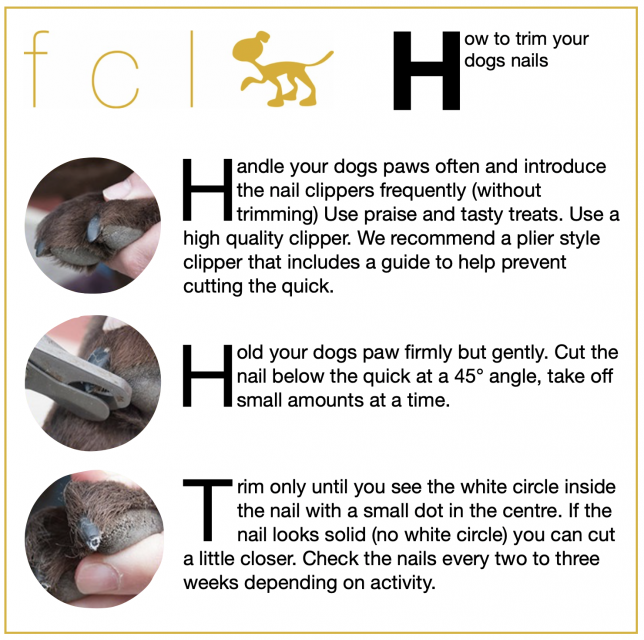
How to Trim Nails
Can certain breeds of dogs be hypoallergenic?
Can certain breeds of dogs be “hypoallergenic” or less prone to provoking allergies in owners, and does a dog’s coat type, fur, or hair make any difference?
Fur and hair are technically the same, constructed of keratin, and each grows out of hair follicles. The difference is how each strand of hair grows and its purpose.
You’ve probably heard that certain dog breeds may be “hypoallergenic,” for example, the Labradoodle and Cockapoo. Whether the pet has fur or hair and how that affects allergies may differ from what many would expect.
Dogs with a fur coat tend to have two layers, a top coat and a soft undercoat that helps them regulate a comfortable body temperature. Fur coats also tend to shed more and disperse in the air with shorter growth cycles. These breeds include the Cavalier King Charles, Golden Retriever, Labrador, Husky and Pomeranian, to name a few.
Dogs with hair include Miniature Poodle, Bichon Frise, Maltese, Yorkshire terrier, Miniature Schnauzer, Shih Tzu, and Havenese.
Contrary to popular belief, dogs with hair or fur aren’t inherently hypoallergenic. That’s because what induces allergies is typically the dander (skin particles) and dried saliva present on a dog’s coat, not the hair itself. Every dog carries dander, so whether a dog has fur or hair isn’t going to solve allergy problems altogether.
Hair, however, does retain dander better than fur. Dogs with hair tend to shed less and trap shedding hair in their coat, preventing dander from becoming airborne. Dogs with fur tend to release dander allergens more readily. Their coats are shorter and shed on furniture and other surfaces.
The first misconception that certain dogs can be hypoallergenic results from containment rather than elimination. The dander and dead hair will not easily fall or shed from the coat of breeds such as Poodles, Labradoodles, Goldendoodle, Cavapoos, Poochons and Yorkiepoos, resulting in less contact with airborne allergens.
Cross-breeding with poodles became very popular to limit the chances of being allergic to a pet dog, which it does, but it may create other problems. Poodles have hair which retains dander better than some other coat types. They also contain the shedding hair as it falls from the hair follicle to make way for a new coat. The dead hair and dander are trapped with the growing hair rather than shedding onto furniture and household surfaces which may lead to the effects of allergy in some people.
The second misconception is that these breeds do not need to be brushed or groomed as often because they do not shed their coat. Indeed, they shed their coat and skin just the same as any other breed of dog with hair or fur. Any dog with hair that is considered hypoallergenic will need a great deal of attention (brushing) to prevent the coat from matting with trapped dead hair and dander. The trapped hair must be removed manually by brushing and combing the coat. Owners with allergies to a dog’s fur or hair or those considered hypoallergenic should wear a face mask to prevent breathing in the dander while attending to the daily brushing requirements of their dog.
Shedding and Different Coat Types
Shedding
If you are a Pug, Boxer dog, Beagle or Labrador owner you will know that your dog seems to shed their coat prolifically all year round. If you own a Miniature Schnauzer, Poodle, Boston Terrier or Smooth Haired Dachshund you will know that they barely seem to shed at all. All dogs go through a distinct cycle of growth and loss throughout the year depending on breed and coat type. Some dogs will shed at a steady rate and others shed their coat with the changing seasons. Simply put the old coat is replaced with a new coat. How easy or difficult the coat is to maintain depends on the type of coat your dog has.
Coat Types
In addition to the various coat types we have outlined here, your dog’s coat may also be Double Coated. These coats have two distinctive layers to fulfil different roles. This is a coat type adapted to all weathers and includes the Golden Retriever, Bearded Collie, German Shepherd dog, Australian Sheppard Dog, Border Collie, Golden Retriever, Pomeranian, Yorkshire Terrier and Pembroke Welsh Corgi.
Additionally, all dog coat falls into two major categories – undetermined length (UDL) and predetermined length (PDL). Some people use the terms HAIR (UDL) and FUR (PDL) to distinguish between these two types. The length of Hair, like ours, will just grow and grow until it is cut. Fur will grow to a certain length and stop.
Each of these different coat types required very different grooming approaches, tools, and care.
In winter when it’s cold, wet and dirty, the longer guard hairs protect the undercoat from getting wet and from dirt penetrating the coat to the skin. When the undercoat is dry your dogs stay insulated from the cold. This same protective functionality is also designed to keep your dog comfortable in hot weather too. This coat also protects the skin from summer biting insects and from the suns damaging UVA & UVB rays. Remove the coat and we remove the skins natural protection. A dogs skin is much thinner than our own, the fur is there for that reason. Dogs with double coats will naturally shed the warm dense undercoat as the weather warms up leading to a finer coat perfectly suited to keep the skin cool, shaded and protected from the summer sun. The key to keeping your dogs coat ‘fit for function’ is to brush and comb at least three times a week, if not daily, with a brush that is suited to this coat type, preferably an ActiVet Brush and keep the coat clean. The undercoat must be kept free from matting and tangling to keep the whole coat healthy and well-conditioned. Clipping down certain breeds with this coat type whether long or short could also damage the coat, resulting in patchy, fluffy regrowth which looks unsightly and will take a long time to regrow and get back into a natural growth cycle. This also applies to all-natural coated dogs where the coat grows to a pre-defined length. Long Haired Chihuahua’s and Pomeranian’s, for example, may have permanently damaged coats if clipped down unnecessarily.
So whatever the weather this summer, FCL would not be looking at shaving off your Border Collie, Golden Retriever, Shetland Sheepdog or Samoyed. Instead, always provide your double-coated dog with shade on sunny days and provide fresh clean water at all times. Keeping the coat free from shedding undercoat with effective regular brushing and combing is the key to keeping the coat in perfect condition, which in return takes care of your dog. Brushing is a need of the breed. A Pyrenean Mountain Dog, Newfoundland or Bearded Collie will require effective daily brushing. Missing just days, a week or two weeks of effective brushing can result in serious matting where the tight coat caused discomfort and can lead to additional skin problems if left unattended for several weeks. Dry air in summer or winter will also mean the undercoat mats more easily. Dogs kept indoors with central heating are just as susceptible as those kept outdoors, keep brushing whatever the weather, season or environment. If you have neglected to brush the coat according to the need of your breed and it has become matted or felted (pelted) then clipping the coat very short may be the last resort for the welfare of your pet to reduce further discomfort. If your dog is brought to FCL for regular professional grooming we will work with you to ensure your dog’s coat is kept in optimum condition.
Make a well-informed, educated choice before choosing any breed of dog. Embrace the beautiful coat your dog has and accept your responsibility for the animal in your care. There are between 300 and 400 breeds of domestic dogs to choose from and approximately ten different types of dog coat, thanks to years of human genetic engineering of the dog and its functions. so choose wisely.
Double Coated Breeds.
In addition to the various coat types we will identify here, your dog’s coat may also be Double Coated. These coats have two distinctive layers to fulfil different roles.
This is a coat type adapted to all weathers and includes the Bearded Collie, German Shepherd dog, Australian Shepherd Dog, Border Collie, Golden Retriever, Pomeranian, Yorkshire Terrier and Pembroke Welsh Corgi.
Additionally, all dog coat falls into two major categories: Undetermined length (UDL) and predetermined length (PDL). Some people use the terms HAIR (UDL) and FUR (PDL) to distinguish between these two types. The length of Hair, like ours, will just grow and grow until it is cut. Fur will grow to a certain length and then stop growing.
Each of these different coat types required very different grooming approaches, tools, and care.
In winter when it’s cold, wet and dirty, the longer guard hairs protect the undercoat. When the undercoat is dry your dog’s skin will stay insulated from the cold. This same protective functionality is also designed to keep your dog comfortable in hot weather too. This coat also protects the skin from summer biting insects and from damaging UVA & UVB rays. Remove the coat and we remove the skin’s natural protection. A dog’s skin is much thinner than our own, the fur is there for that reason. Dogs with double coats will naturally shed the warm dense undercoat as the weather warms up leading to a finer coat perfectly suited to keep the skin cool, shaded and protected from the intensity of the summer sun.
The key to keeping your dogs coat fit for function is to brush and comb at least three times a week, if not daily, with a brush that is suited to this coat type, preferably a professional quality slicker or pin brush. The undercoat must be kept free from matting and tangling to keep the whole coat healthy and well-conditioned. Clipping down certain breeds with this coat type whether long or short could damage the coat, resulting in patchy, fluffy regrowth which looks unsightly and will take a long time to regrow and get back into a natural growth cycle. This also applies to all-natural coated dogs where the coat grows to a pre-defined length. Long Haired Chihuahua and Pomeranian, for example, may have permanently damaged coats if clipped down unnecessarily.
So whatever the weather this summer, FCL would not be looking at shaving off your Border Collie, Golden Retriever, Shetland Sheepdog or Samoyed. Instead, always provide your double-coated dog with shade on sunny days and provide fresh clean water at all times. Keeping the coat free from shedding undercoat with effective regular brushing and combing is the key to keeping the coat in perfect condition, which in return will take care of your dog.
Brushing is a need of the breed. A Pyrenean Mountain Dog, Newfoundland or Bearded Collie will require effective daily brushing. Missing just days of effective brushing can result in serious matting where the tight coat caused discomfort and can lead to additional skin problems if left unattended.
Dry air in summer or winter will also mean the undercoat mats more easily. Dogs kept indoors with central heating are just as susceptible as those kept outdoors, keep brushing whatever the weather, season or environment. If you have neglected to brush the coat according to the need of your breed and it has become matted or felted (pelted) then clipping the coat very short may be the last resort for the welfare of your pet to reduce further discomfort. Wool or curly Coated Breeds
Wool or Curly coats include the Bichon Frise, Poodles, Bedlington’s and the popular poodle mixed breeds like Labradoodles, Cavachon and Cockapoo. This coat can be thick, curly and has a lot of volume. This coat requires the maximum amount of regular effective daily grooming. The owner who is successful in keeping this coat in good condition will brush it daily. This is one of the hardest coats to maintain. It mats very easily and can grow quite quickly and these dogs have continuous growth throughout the year. The term ‘hypoallergenic’ is often confused with easy care which couldn’t be further from the truth. These coats are often referred to as the Non-Shedding Coats. Whilst the undercoat will indeed not fall out it will need to be removed manually by brushing, involving lots of time and effort to prevent matting and tangling. This is one of the most expensive coat types to be professionally groomed and the one that tends to incur additional costs due to a lack of effective daily grooming.
Smooth-coated dogs are the easiest to maintain and require the least amount of grooming. Their coat lays flat to the skin, is shiny and lacks texture. They do shed their coat but it is minimal and you won’t notice the hair loss so much on your clothes and in your home. This coat type includes the Whippet, Greyhound, French Bulldog, Staffordshire Bull Terrier and Boston Terrier.
Short to Medium coated dogs have two layers of short coat, making these coats very dense. They tend to arise in those breeds that spend a lot of time outdoors to protect them from the elements. The hair is short in length, typically 1 cm to 3 cm. This coat has more texture, and you can put your fingers through it. Pugs, Boxer Dogs, Labradors, Australian Cattle Dogs and Beagles, for example, require only occasional grooming. The coat, however, will hold more water, taking more time to dry and tends to hold on to smells.
Silky-coated dogs have a long coat, which requires a lot of maintenance. This coat needs effective brushing at least three times a week, preferably daily. Breeds include the Golden Retriever, Old English Sheepdog, Shih Tzu, Maltese, Lhasa Apso, Afghan Hounds, Tibetan Terrier and the Yorkshire Terrier. Long coats vary in texture from coarse to silky. This is also one of the most expensive coat types to be professionally groomed and another that tends to incur additional costs due to a lack of effective home grooming.
Wire coat dogs have specialised grooming requirements. Full grooming generally needs to be done by a professional groomer or someone trained to deal with this coat. This coat type includes the Border Terrier, Irish Terrier, Affenpinscher, Scottish Terrier and the West Highland Terrier.
The correct way to groom the wire coat is through a process called hand stripping. Hand stripping maintains the wire coat’s colour and coarse texture. This is a process which must be done from being a puppy. Once the coat is clipped, it is very difficult, if not impossible, to get the texture back by hand stripping. Neutering and home bathing may affect the texture of the coat and, therefore, the ability to strip the coat comfortably. Hand stripping has to be taught and is labour-intensive. Hand stripping will make grooming more expensive than clipping the coat.
Hand stripping involves pulling out the dead outer coat of wire-coated and rough-coated breeds by hand rather than clippers. This allows the new harsh wire coat to grow. Wire coats pull out very easily once the coat is ready, which should be a comfortable experience for your dog. The wire or rough coat has a unique structure, which is why it is so specialised. The coat has a soft undercoat, semi-hollow hair and a wire outer coat. When your dog’s hormones decide, the coat will be ready to shed and anchored very lightly into the skin. The hair can be removed by hand, retaining the natural wire texture and colour as the hair regrows.
When you clip the coat with electric clippers, the coarse wire hair will be removed. All that will be left is the semi-hollow hair or the soft base. This will make the coat soft, and the colour will be diluted. That’s why some black dogs, when they are clipped, begin to turn grey or chestnut brown coats turn pale.
Combination coats are another unique coat type. A breed with a combination coat has areas of long coat and shorter coat. The two types of coats are easy to tell apart. Generally, the shorter coat is on the body, and the long coat is on the ears, legs and tail. This coat type requires regular grooming to brush out dead hair from the longer areas of the coat around the rear, chest and ears to prevent matting. This includes the English Springer Spaniel, Border Collie and Irish Setter.
Hairless dogs usually have some hair on the top of the head, feet and tail and still require gentle bathing to keep the skin in good condition but are essentially easy to maintain. Sunblock is recommended when outside in the sunshine.
Corded Coats. Cording is a technique in which dog coats are separated into dreadlocks for coat care or showing purposes. Dog breeds that are often corded are the Puli and the Komondor. The cords are carefully separated in clumps of fur in a regular pattern and tended until they are long enough to grow on their own. These coats collect dust and debris and can be difficult to maintain if the owner is unfamiliar with the breed and coat type. The coat must dry naturally after bathing.
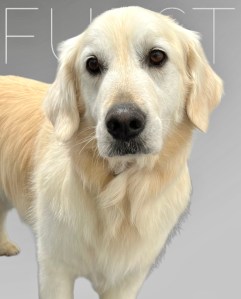
The Golden Retriever
Heavy shedding coat – Requires regular home brushing and grooming
Professional Grooming | 8 to 12 weeks
Silky | Double | Combination
External Anatomy

What causes dog clipper lines?
Professional grooming means a dog is groomed to a high standard and ideally should not have signs of clipper marks after clipping short, as is the case with cocker spaniels, for example. When the coat is clipped velvety short (7F), the groomer needs to take their time, work slowly with the clippers held level with the skin, and use light pressure. The groomer needs to use slow strokes on the back and sides, always going with the lay of the coat grain, which should be backcombed or brushed up without changing direction. The pressure with the clipper should be even at all times, as too much fluctuation can leave lines that can be hard or impossible to remove. The element of consistent control results in a smooth, even finish without visible clipper lines.
So why do clipper lines sometimes appear after clipping short? Well, doing just the opposite will cause clipper marks. Using inconsistent pressure, not flowing in the direction of coat growth, changing direction with the clipper, and not keeping the blade flat against the skin will all contribute to clipper lines.
There are coat types that are more difficult to clip smooth. For example, a cocker spaniel with a silky coat, particularly the fawn through to red colours, is the most challenging to achieve a perfect finish. With this coat type, the groomer must pay close attention to the consistent method of clipping using a short clipper blade.
The clipper blade should remain flat while gliding over the skin. Where a dog is very slim and bony or has rolls of fat, the skin should be stretched out if possible because skipping over these areas will also add to the difficulty of achieving a smooth finish.
Suppose the dog being groomed is unacclimatised to the grooming environment and is active and energetic, moving around the table. In that case, the result will likely be heavily lined due to the inconsistent position and pressure of the blade due to the dog’s movement.
The groomer must have complete control over a dog that is standing steadily to achieve the ideal results, from clipping a silky coat, in particular, to a high standard.
When the groomer is working with a dog not standing reasonably still on the grooming table and using a short body blade such as the 7F, it is unlikely that the coat will be finished to a high standard. The owner should consider an alternative style or longer coat length if they report or express dissatisfaction due to clipper lines in their dog’s coat after being groomed.
Wool or curly-coated dogs are less likely to show clipper lines due to the nature and structure of the coat; however, the same consistent methods should be applied for a smooth finish.
The Cycle of Canine Coat Growth
As you may have read in Shedding & Coat Types, a dogs coat comes in various lengths and textures which determine how the coat should be groomed and the level of time involved in maintenance.
Have you ever wondered why your dogs coat seems to grow faster and then seems to hardly grow at all between grooming appointments? Understanding the shedding life cycle of your pets hair can help you appreciate that, at times, your pets coat may need more attention to grooming!
Breeds and individuals within every breed will shed and regrow hair at varying rates. If a dog sheds more often it is more noticeable than if they shed extensively but for a period of only several weeks. Indoor dogs, because of artificial heat and more importantly light, tend to shed in a more or less continuous fashion. Dogs kept outside tend to shed for several weeks during major seasonal changes, most notably in spring and Autumn. Usually they grow more guard hairs or undercoat in the winter for warmth. In the spring they lose the undercoat and replace much of it with the longer guard hairs. The coat changes in appearance, density and texture but the numbers of hair follicles does not.
The growth process of a dogs coat is different to our own. Some dogs have more than one hair type growing at the same time in varying textures and layers from a single hair follicle. Regardless of the type of coat your dog has the hair goes through four stages of growth and renewal. Sometimes in very clearly defined shedding stages, seasonally with most double coated breeds and in other breeds continuous shedding.
Anagen Phase – This is when the new hairs are in an active state of growth
Catagen Phase – This is when the new hairs reach their maximum length and stop actively growing
Telogen Phase – This is when the hair becomes dormant, fully attached to the skin but not growing and is ready to be pushed out by new growth
Exogen Phase – When the hair reachs the end of its natural lifecycle and is shed from the follicle
Then the cycle starts all over again!
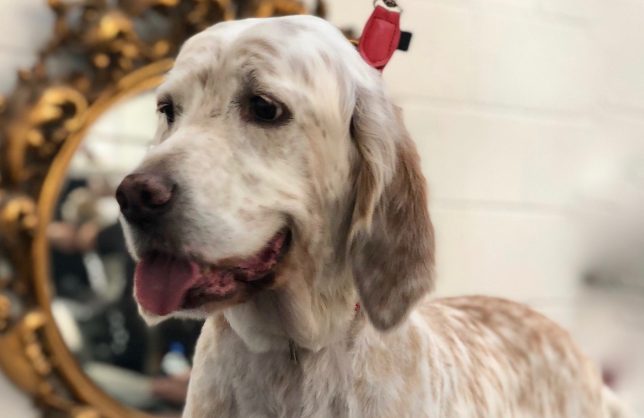
Changes in Coat Growth (Cowlicks or Crowns)
Changes in coat growth occur in areas where the coat changes the direction of growth, for example on the sides of the neck behind the ears, fore-chest area, under the tail and on the rear side of the forearms from the outer elbow down towards the pastern where the change of coat growth appears as a long parting in the coat. These crowns form swirls or rosettes in the coat when these areas are covered in hair and are often referred to as cowlicks. When the coat is trimmed short, particularly 7F (3.2mm). The pattern where the change of coat growth occurs will be different in the individual dog. These areas are more likely to be revealed at lengths of 10mm or less and may appear to be shaved or a mistake but are naturally forming.


Everything You Need to Know about Matting, Felting and Shaving Off
Go to Page >
Psychological Stages of Development (Scott & Fuller)
“Genetics and the Social Behaviour of Dogs” published in 1965 by Dr John Scott and Dr John Fuller is still regarded as one of, if not the most, important and comprehensive studies on the development and behaviour of the domestic dog. Below is a very brief outline of the stages they identify as being crucial in the development and socialisation of puppies and young dogs.
A dog has ten clear stages of psychological development which affect how it interacts with people and other animals and controls its behaviour in situations dependant on its age. Puppies develop through clearly recognisable stages, each one being characterised by certain behaviour patterns and emotional reactions. These have been called The Ten Stages and are discussed in further detail below.
1. Pre-Natal Period
Environmental factors that affect the pregnant bitch also affect the subsequent development of the puppies mind. This is why it is critical to give the bitch good all round care.
2. Neo-Natal Period (0-2 weeks)
During this period the dog spends around 90% of its time asleep. The hearing, vision and temperature regulation are under developed and the pup’s brain is barely myelinated. The way in which a dam behaves with her offspring will greatly influence its behaviour in later life.
3. Transitional Period (2-4 weeks)
During this period, the sensory abilities come on line, the eyelids open and the first set of teeth appear, the dog will wag his tail and bark for the first time, at this time the litter mates play a much more important role.
By four weeks of age, hearing, pain, touch and vision responses are similar to that of an adult, the brain is almost fully myelinated and the dog is ready for complex learning.
4. Socialisation Period (To Dogs – 4-6 weeks / To Dogs Humans 4-12 weeks)
From 3 1⁄2 weeks the pups begin to interact playfully. From this age the pup learns through play, how much pain they can inflict on each other as a result of chewing and biting.
The facial expressiveness of the puppy at five weeks contrasts to the mask like appearance of the puppy at three weeks. This is due to the development of expressive ear movements, elongation of the muzzle and the improved functions of the muscles that control the lips.
At 4-5 weeks of age, puppies frequently carry small objects in their mouths and engage in tugs of war. A defensive protective pattern emerges, in which the pup vigorously guards an object or food. Several puppies may follow one litter mate who is carrying something in its mouth. These are the first signs of co-ordinated group activity, or pack performance and dominant and submissive behaviour.
This is the optimum time for the dog to establish social relations with other dogs, humans and other species.
Scott and Fuller describe this period as a special time in life when a small amount of experience will produce a great effect on later behaviour.
5. First Fear Impact Period (8-11 weeks)
Any traumatic experience, whether it be frightening or painful will have a more lasting impact on the puppy now, than if it had occurred at any other time in its life.
6. Juvenile Period (12 weeks to maturity)
Most of what occurs in this period will be determined by what went on before. The dog will experience gradual improvement of the motor skills as he grows in strength and activity. Consistency is the key during this period, ensuring the dog knows its boundaries is key to guaranteeing that you don’t have unwelcome behaviour. If the dog hasn’t developed normally through the previous stages, then socialisation must take place during this stage.
7. Seniority Classification Period (4-8 months)
This is often referred to as the ‘Age Of Cutting Teeth’. This period is defined by the dogs test for leadership, very similar to teenage children; the dog will test all members of his pack for weaknesses and then, if allowed, exert his authority and move higher within the pack position.
8. Flight Instinct Period (4-8 months)
Turning a deaf ear is classic behaviour in this period; the dog will often disobey commands, run away, or turn a deaf ear. It can last a few days or weeks and is again, a test of the owner’s position in the pack.
9. Second Fear Impact (6-14 months)
This is a stage that most people do not understand. It could occur once, or several times, depending on the dog. It is marked by a sudden change in behaviour of the now adolescent dog who may suddenly be reluctant to approach something new, or be frightened of something, or someone familiar. The way in which an owner reacts in this stage is crucial to the dog’s normal development.
10. Maturity (1-3 years)
Maturity is a very vague stage, as some breeds do not mature until they are 3-4 years, however, whenever the maturity is reached, it is usually marked by a renewed test for leadership of the pack, especially in male dogs and again, the way in which the owner responds to this is critical.
The way in which breeders, handlers and owners respond to a dogs behaviour is crucial at all the above stages of development, one mistake and the dogs development could quite easily be set back. This would then need further work and training to ensure the dog grows into a well adjusted, social animal, comfortable in all surroundings.
Redcape Grooming Supplies
Recommended Reading & Reference
Notes from the Grooming Table – SECOND EDITION
An All-Breed Reference Guide for the Professional Pet Groomer and Stylist. Full of detailed illustrations and information.
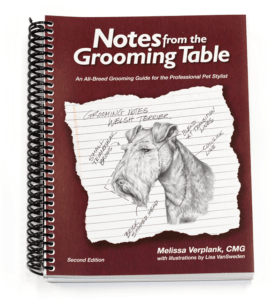
Winner of the 2016 Barkleigh Honors Award for Book of the Year.
This is the NEW SECOND EDITION of the book that has set the industry standard for dog grooming reference guides. You get step-by-step instructions and beautiful, easy-to-follow illustrations that have made this book a must-have for groomers and stylists worldwide. Written by esteemed stylist, speaker, and judge Melissa Verplank (CMG) and featuring gorgeous illustrations by renowned wildlife artist Lisa Van Sweden, this amazing guide is based on Ms Verplank’s years of experience and expert grooming skills. Notes From the Grooming Table has put thousands on the path to beautiful grooming.
Notes From the Grooming Table – SECOND EDITION is a comprehensive grooming guide that includes information on basic pet grooming techniques on over 200 AKC-recognised breed standards.
In this new version, you get the following:
- Grooming instructions and illustrations for over 200 breeds.
- One hundred forty-five added pages!
- A complete index to make searching even more accessible!
- A completely remastered tools and equipment section, including new information on shears, brushes, clippers, stripping tools, and so much more!
- Completely new metal guard comb section.
- An updated clipper blade length section.
- Two new bathing and drying sections, including special instructions and illustrations.
- New sections describing each dog group’s historic function and design have been added.
- Fifty-one new breeds have been added, including Hairless and Rustic coats.
- Includes detailed sections on classic Poodle and drop coat styles.
- The entire book has new and updated breed profile styling.
- features a double coil binding with a stick fastener for easy page turning
One of the most comprehensive grooming guides available.
FURST CLASS LOUNGE LIMITED All Rights Reserved© 2023